
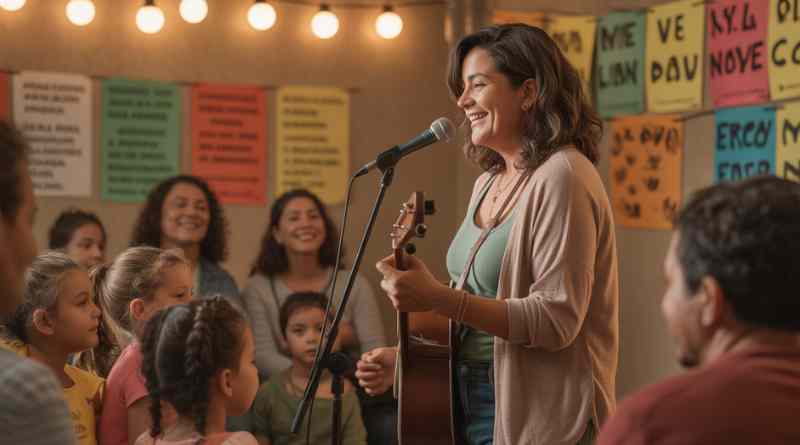
Maura Mendoza Garcia: Singer, Educator, and Advocate
There are people who choose between art and service. Then there are people like Maura Mendoza Garcia, who never had to make that choice because, for her, they were always the same thing.
Maura Mendoza Garcia is a Salvadoran-born singer-songwriter, multilingual educator, and community advocate based in Somerville, Massachusetts. Over a career spanning more than two decades, she has built something rare: a life where music and education are not separate paths but a single, unified mission.
Her work touches immigrant families, public school students, educators, and community members across Massachusetts. She performs in seven languages, coordinates multilingual services for an entire school district, and has contributed to published academic research on arts-based family engagement.
This is her story.
Quick Facts About Maura Mendoza Garcia
Before diving into the full picture, here is a clear overview of who she is and what she does.
| Detail | Information |
|---|---|
| Full Name | Maura Mendoza Garcia (also cited as Maura Mendoza Quiroz) |
| Origin | El Salvador |
| Current Location | Somerville, Massachusetts, USA |
| Profession | Singer-Songwriter, Bilingual Educator, Community Liaison |
| Languages She Performs In | Spanish, English, Portuguese, French, Italian, German, Hindi |
| Education | Performing Arts, Havana, Cuba; Musical Theatre, Mexico City, Mexico |
| Current Role | Multilingual Services Coordinator, Somerville Public Schools |
| Notable Publication | Multilingual Family Engagement Through the Arts (2017, co-authored) |
| Fellowship | Massachusetts Aspiring Latino Leaders Fellow (2023) |
| Affiliated Organizations | Somerville Public Schools, Latinos for Education, Cambridge Arts Council |
| Career Span | 20+ Years |
This table gives you the essentials. But the numbers and titles only tell part of the story. The rest is in how she got here.
Growing Up in El Salvador: A Childhood Shaped by Art and Resilience
Maura Mendoza Garcia was born in El Salvador, a small Central American country that spent much of the 1980s in the grip of a devastating civil war. Between 1979 and 1992, the conflict reshaped everyday life for ordinary families. Schools were disrupted, communities were displaced, and uncertainty became part of daily existence.
In environments like that, culture often becomes a lifeline. Music, storytelling, theater, and communal performance are not luxuries during difficult times. They are how people hold onto identity when everything else feels unstable. Research on arts in conflict-affected communities consistently shows that creative expression helps children process fear, maintain a sense of normalcy, and stay connected to cultural roots.
Maura grew up in that world. From a young age, she took part in school performances, theatrical productions, and cultural events. She was not just a passive participant. She engaged deeply, the kind of child who finds something essential in standing on a stage and telling a story.
Her artistic exposure also extended beyond El Salvador. During her formative years, she participated in performances and cultural activities in Panama, broadening her early understanding of Latin American artistic traditions. These cross-border experiences planted a seed: the idea that music and performance could connect people across geography, language, and background.
That seed would grow into an entire career.
Maura Mendoza Garcia’s Age and Educational Background
Maura Mendoza Garcia has not publicly disclosed her exact date of birth, which is a personal choice many public figures make, particularly those whose work is focused on community service rather than celebrity. Based on her timeline, including her upbringing in 1980s El Salvador, her international studies, and a professional career of over 20 years, she is generally estimated to be in her late 40s to early 50s as of 2026.
What is far more documented and impressive than her age is her education.
After completing her early schooling in El Salvador, she pursued formal arts training at an international level. She studied performing arts in Havana, Cuba, a city with one of the richest musical and theatrical cultures in the entire Western Hemisphere. Havana has produced world-renowned performers, composers, and artists for generations. Cuban musical traditions, from son cubano to Afro-Cuban jazz, are studied globally. Training there is not a casual credential. It reflects serious artistic commitment.
She then moved to Mexico City to study musical theatre. Mexico City is Latin America’s cultural capital in many ways, home to a vibrant, sophisticated arts scene that blends indigenous traditions with European theatrical forms. Studying musical theatre there means engaging with a rigorous, diverse, and deeply human art form.
What this two-country education gave Maura was something beyond technique. It gave her a multilingual, multicultural lens through which to see performance. It shaped her belief that music is not the property of any single culture. It belongs to everyone. That belief would later define everything she built in Massachusetts.
From El Salvador to Massachusetts: Her Journey to the United States
Maura Mendoza Garcia arrived in the United States in the mid-2000s and eventually settled in Somerville, Massachusetts, a city just north of Boston known for its cultural diversity and strong immigrant communities. At the time of her move, Somerville was already one of the most linguistically diverse cities in New England.
Rebuilding an artistic identity in a new country is harder than it sounds. Immigrant artists often face the same challenges as all immigrants, navigating a new system, a new language in professional contexts, new cultural expectations, while also carrying the specific challenge of making their art understood and valued by audiences who may not share their background.
For Maura, that challenge became the work itself. Rather than setting aside her multicultural identity to fit into a narrower American arts market, she leaned into it. Her diversity of languages, her broad artistic training, and her lived experience as an immigrant became the foundation of a mission-driven practice focused on the very communities she understood from the inside.
She embedded herself in local schools, cultural organizations, and community events. She did not arrive with a polished brand. She arrived with a purpose.
Maura Mendoza Garcia’s Music: A Voice That Crosses Borders
Maura Mendoza Garcia is not easy to categorize as a musician, and that is precisely the point.
Her work spans Latin folk, jazz, pop, rock, and children’s music. She draws on multiple traditions without belonging exclusively to any of them. The result is a sound that feels both rooted and open, familiar to many listeners while surprising them at the same time.
What truly sets her apart is her multilingual repertoire. She performs in Spanish, English, Portuguese, French, Italian, German, and Hindi. Seven languages. That is not a gimmick or a novelty. It reflects a genuine, deeply held philosophy: that music becomes more powerful when it speaks to people in their own language.
For immigrant families in Massachusetts, hearing a performer sing in the language of their home country is not a small thing. Language carries memory, emotion, and identity. When a song arrives in your mother tongue in the middle of a school auditorium in America, it sends a message that you are seen. You belong here too. Your culture has a place at this table.
Maura understands this at a personal level. She has lived it.
Her performances are also notably interactive and intergenerational. She does not perform at audiences. She performs with them. Parents, children, grandparents, teachers, all are invited to participate. These are not passive concerts. They are shared experiences designed to build connection across generations and bridge gaps between families and the institutions meant to serve them.
Her performances have been featured through initiatives supported by the Cambridge Arts Council, appearing at community festivals, school events, public libraries, and cultural gatherings throughout the region. The consistent thread across all of it is inclusion. Everyone is welcome. Everyone can contribute.
Her Work With Somerville Public Schools and Immigrant Families
Music is one dimension of Maura Mendoza Garcia’s work. Her role within the Somerville Public Schools system is another, and arguably the one with the most direct daily impact on real families.
She works as a Multilingual Services Coordinator and family outreach liaison for the district. In practical terms, this means she serves as a bridge between the school system and the families it serves, particularly immigrant and non-English-speaking households.
Consider what that role actually involves. A parent who speaks Haitian Creole, Portuguese, or Spanish receives a notice from their child’s school. They cannot fully understand it. They feel uncertain about attending a meeting, confused about a process, or disconnected from decisions being made about their child’s education. That disconnection is not a failure of the parent. It is a failure of communication, and it has real consequences for children’s academic outcomes.
Maura’s work helps close that gap. She facilitates communication, organizes culturally sensitive outreach, and creates programming that makes schools feel accessible rather than intimidating for families from diverse linguistic backgrounds.
Her connection to Latinos for Education further extends this work. This organization focuses on building a pipeline of Latino leaders in education across Massachusetts. Maura’s involvement reflects her broader commitment to systemic change, not just individual outreach.
Her arts-based workshops inside schools are a particularly creative and effective tool. These sessions bring parents and children together around music, storytelling, and creative activities. For many immigrant parents, especially those who feel uncertain in formal school settings, participating alongside their child in an arts workshop lowers the barrier to engagement. It replaces anxiety with participation.
Researchers and educators working in the field of family engagement consistently find that when schools use culturally responsive, arts-based approaches, parental involvement increases. Maura is not just practicing this philosophy. In many ways, she helped develop it.
Co-Author, Researcher, and Thought Leader in Arts-Based Education
In 2017, Maura Mendoza Garcia co-authored a chapter titled Multilingual Family Engagement Through the Arts. This is not a blog post or a conference handout. It is a formal, peer-informed academic contribution to the field of educational research.
The chapter explores how creative expression, including music, visual arts, and storytelling, can function as a practical strategy for increasing family engagement in schools, particularly among immigrant and multilingual households. It draws directly on her hands-on experience working within real school systems with real families.
The significance of this publication goes beyond the content itself. It establishes Maura as a thought leader, someone whose practical expertise is credible enough to contribute to the academic conversation shaping how schools across the country approach family engagement. Policymakers, curriculum designers, school administrators, and academic researchers are the audience for work like this.
Her writing and ideas are referenced in discussions about culturally responsive education, a growing field within educational theory that argues academic success is deeply tied to whether students and families see their cultural identities reflected and respected within school environments. Maura is not a peripheral voice in that conversation. She is a contributor to it.
Massachusetts Aspiring Latino Leaders Fellowship (2023)
In 2023, Maura Mendoza Garcia was selected as a Massachusetts Aspiring Latino Leaders Fellow. This recognition deserves more context than it typically receives.
The Massachusetts Aspiring Latino Leaders program is designed to identify and develop Latino educators and community leaders who are already demonstrating exceptional impact in their fields. It is a competitive, selective fellowship, not a participation award. Selection reflects a genuine assessment of leadership quality, community contribution, and the potential to influence educational systems at a larger scale.
For Maura, this recognition validated what the communities she serves already knew. Her work is not just meaningful at the individual level. It is the kind of work that can be studied, replicated, and scaled.
The fellowship also connects her to a network of Latino leaders across Massachusetts, amplifying her reach and reinforcing her role as a voice in statewide conversations about educational equity, multilingual programming, and immigrant family support.
Why Maura Mendoza Garcia’s Work Matters Today
This section does not appear in most profiles of Maura Mendoza Garcia. But it may be the most important one.
The United States is home to approximately 49 million immigrants, representing nearly 15 percent of the total population. In states like Massachusetts, immigrant families make up a significant portion of public school enrollment. These families navigate language barriers, cultural unfamiliarity, and institutional systems that were not always designed with them in mind.
Research from organizations like the National Center for Family and Community Connections with Schools consistently shows that when parents are actively involved in their children’s education, students perform better academically, attend school more consistently, and develop stronger social and emotional skills. The challenge is not motivating immigrant parents. Most are deeply motivated. The challenge is removing the barriers that prevent their engagement.
Maura’s model, combining multilingual music, culturally inclusive arts programming, and direct community outreach, directly addresses those barriers. It is practical, replicable, and grounded in real community needs.
Beyond Massachusetts, her approach offers a template that schools across the country could adapt. Urban districts with large immigrant populations, from Los Angeles to Chicago to New York, face the exact same challenges her work addresses. The tools she uses, language-inclusive performance, arts-based parent workshops, multilingual coordination, are not expensive or complicated. They require commitment, cultural competence, and a genuine belief that every family deserves to feel at home in their child’s school.
That belief is at the core of everything Maura does.
Frequently Asked Questions About Maura Mendoza Garcia
Who is Maura Mendoza Garcia?
Maura Mendoza Garcia is a Salvadoran-born singer-songwriter, bilingual educator, and community advocate based in Somerville, Massachusetts. She works as a Multilingual Services Coordinator for the Somerville Public Schools and has spent more than two decades combining music and education to support immigrant families. She is known for performing in seven languages and for her arts-based approach to family and community engagement.
What languages does Maura Mendoza Garcia perform in?
She performs in Spanish, English, Portuguese, French, Italian, German, and Hindi. This seven-language repertoire is central to her artistic philosophy. She believes music reaches people most deeply when it speaks their own language, and in communities where dozens of languages are spoken at home, her multilingual performances send a powerful message of inclusion and cultural recognition.
Where is Maura Mendoza Garcia from originally?
Maura Mendoza Garcia was born and raised in El Salvador. She grew up during the 1980s civil war era, a period that shaped her resilience and deepened her connection to artistic expression as a tool for community and identity. She later studied performing arts in Havana, Cuba, and musical theatre in Mexico City before eventually settling in Somerville, Massachusetts in the mid-2000s.
How old is Maura Mendoza Garcia?
Maura Mendoza Garcia has not publicly shared her exact date of birth. Based on her timeline, including her upbringing in 1980s El Salvador and a professional career spanning over 20 years, she is generally estimated to be in her late 40s to early 50s as of 2026. Many community-focused public figures choose to keep personal details like birth dates private, and that is a choice worth respecting.
What is the Massachusetts Aspiring Latino Leaders Fellowship?
The Massachusetts Aspiring Latino Leaders Fellowship is a selective program that recognizes Latino educators and community leaders demonstrating significant leadership and impact in Massachusetts. Being selected as a Fellow reflects not just past achievement but the kind of sustained, systemic influence that can shape education at a broader level. Maura was named a Fellow in 2023, recognizing her work in multilingual education, arts-based family engagement, and educational equity within immigrant communities.
What did Maura Mendoza Garcia publish in 2017?
In 2017, she co-authored a chapter titled Multilingual Family Engagement Through the Arts. The chapter explores how music, storytelling, and visual arts can serve as practical tools for increasing the involvement of immigrant and multilingual families in school systems. It is grounded in her direct experience working with real families in real schools. The publication is referenced in broader academic discussions about culturally responsive education and arts-based learning strategies, and it positions her as both a practitioner and a credible voice in educational research.
A Story Still Being Written
Maura Mendoza Garcia’s career does not fit neatly into a single category. She is not just an artist. She is not just an educator. She is not just an advocate. She is all three, working simultaneously, each reinforcing the others.
What she has built in Massachusetts is proof that cultural identity and artistic expression are not soft, optional additions to education. They are essential. They are how communities build trust with institutions. They are how children see themselves reflected in the systems meant to serve them. They are how immigrant families find their footing in a new country without having to leave their old selves behind.
Her story is still unfolding. And if the first two decades are any indication, the next chapter will be just as meaningful.